Friday, 19 May 2017

Alkenes

Alkenes:

Alkenes are a group of hydrocarbons, with a C=C double bond, as not all Carbon atoms are bonded to the maximum number of 4 other atoms.
General Formula: ( Cn H2n )
Functional Formula: ( C = C )
  • All alkenes name ends with – ene.
  • They are Unsaturated hydrocartbons
  • Each member of the alkene differs from the next by a CH2
Capture58
Note: As you go down the group, the mass and boiling point increases.

Branched And Unbranched Alkenes ( Isomerism in Alkenes):
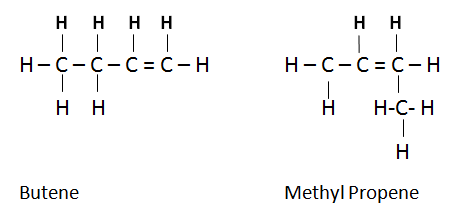
Capture71b
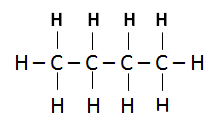
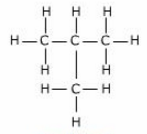
  • They have the same molecular formula C4H8, but have different structural formula.
  • Butene is a straight-chain unsaturated hydrocarbon while methylpropen is a branched-chain, unsaturated hydrocarbon.
  • Butene and methylpropene have different melting and boiling point.

Isomerism for Alkenes:

Isomers can be created in Alkenes by changing the direction of Carbon atoms or by changing the position of Carbon Carbon double bonds (C=C).

Preperation Of Alkenes ( Cracking):

  • Alkenes are created by the cacking of heavier fractions of petroleum.
  • High temperature and pressures are needed to break up the large molecules.
  • The two catalyst used are Alumina Al2O3 and Silica SiOare used.
Note: More details about this topic is given in the Alkanes.

Saturated:

These are those hydro carbons, that have Carbon Carbon single bond (C-C)
In these the combining capacity of the carbon atoms is fully used as possible in bonding with Hydrogen atoms
Note: that Carbon double bond with Oxygen doesn’t make them unsaturated.

Unsaturated:

These are those hydro carbons, that have Carbon  Carbon double bond (C=C).
In these the combining capacity of the Carbon atoms is not fully used e.g 2 or 3 Hydrogens are attracted to a one single Carbon atom.
Test for detecting unsaturated HydroCarbons:
Add liquid Bromine or Bromine water ( reddish brown).
If a C=C bond is present, an addition reaction takes place and the colour will be discharged.
However, in saturated compounds ( where C-C bond is present) Bromine colour will remain same.

Combustion:

All Alkenes will have more Carbon content, then their respective Alkane. Hence they would be needing more Oxygen for combustion.
Thus there is more chances of incomplete combustion.
Complete combustion of Alkenes (Excess supply of O2):
Alkene + OArrow used In Chemical Equation CO2 + H2O
Incomplete combustion of Alkenes (limited supply of O2)
Alkene + OArrow used In Chemical EquationCO + H2O

Addition Of Hydrogen / Hydrogenation:

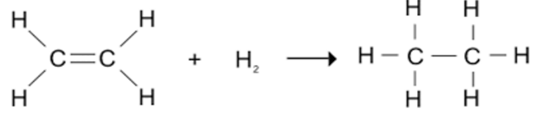
Alkenes react with Hydrogen to form Alkanes.
Alkane + H2Arrow used In Chemical EquationAlkane
  • Catalyst used are Platenum (Pt), Rubidium(Rn) and Nickel( Ni)
  • Temprature required is 200°C.
E.g.
As Alkene is turned into Alkane, Hydrogenation is used, to change vegetable oil, into Margarine.
Capture59
Vegetable oil contains unsaturated fats with many C=C bonds, therefore it can be hardened to form margarine, the greater the Hydrogen used, the more solid(harder), the margarine becomes.
Note: Butter – higher degree of saturation (C-C bonds)
Oil  – higher degree of un saturation (C=C bonds) – liquid bromine can be added to test oil, colour will change.

Addition Of Water (H2o)/ Hydration:

Alkenes react with steam, to produce Alcohols during hydration process.
Alkenes + H2OArrow used In Chemical EquationAlcohol
  • In this process, steam is added onto C=C Bonds in Alkene.
  • Catalyst used are Phosphoric Acid (H3PO4)
  • Temperature required is 300°C
  • Pressure 60 atm
E.g.
C2H4 + H20Arrow used In Chemical EquationC2H5OH
Capture62
Hence, hydration is used to covert Ethene into Ethanol and Propene into Propanol.

Halogenation:

Halogenation is used, to convert Alkene to Alkane
Halogen (group 7 elements) is added across the double bonds of Alkene to covert the C=C to C-C.

Capture63

Note: In substitution reaction in Alkanes, Halogens were added in a step wise reaction, where as in case of Alkenes, Halogens are added up at once.

Polymerization:

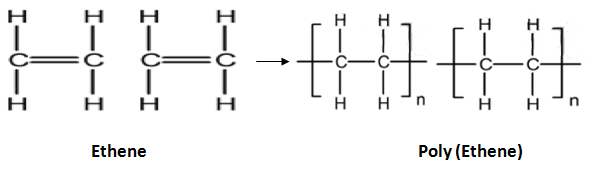
Alkene molecules undergo an addition reaction, where they add on to each other to form addition Polymers. Therefore, in this reaction Alkene molecules are used as Monomers, to form addition Polymers.
Alkene molecules – monomers
Long chained compound formed – polymers
Reaction – polymerization
E.g. Ethene is polymerized to form Poly(ethane) or Polythene.
Capture64
Polyethene  is used to make plastic films, plastic bags and drinking bottles.

Detection Of Alkenes:

Alkenes can be detected by using cold aqueous Potassium Maganate(VII).
The purple colour of the Potassium Maganate(VII) is discharged, leaving behind a brown precipitate of Manganes (IV) Oxide MnO.
The Maganate(VII) ions are reduced to Manganese (IV) Ions.

Difference Between Alkenes And Alkanes:

Similarities:
  • Both are compounds that only contain Carbon and Hydrogen in them.
  • Both are flammable
  • Form CO2 + H2O during complete combustion.

Differences:
  • Molecular structure:
Alkanes  C-C bonds
Alkenes  C=C bonds

  • Reactivity:
Alkanes are mostly unreactive.
Alkenes are more reactive than the Alkanes

  • Reaction with Bromine:
Liquid Bromine when added to Alkane will not change its colour.
Liquid Bromine when added to Alkene will change its colour due to the presence of C=C bonds.
  • During Combustion Alkenes produce a much smokier flame then Alkanes.

Fats And Oils:

Fats:

These are saturated fat molecules. (Solid at room temperature).
 Capture65

Oils:

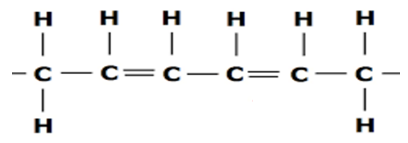
These are un saturated fat molecules. (Liquid at room temperature).
 Capture66

Poly unsaturated:

These are those fats and oils whose hydrocarbon chains contain more than one C=C Bonds in their structure.

Alkanes

Alkanes:

Alkanes are a group of Hydro Carbons having C – C single bonds.
General Formula ( Cn H2n + 2 )
Functional Formula ( C – C )
Alkanes
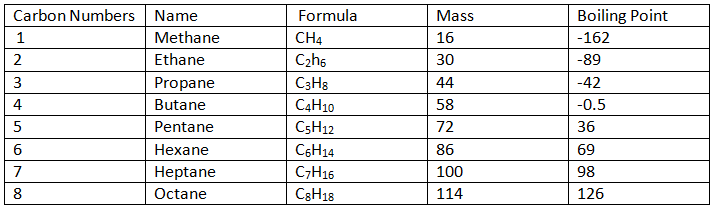
Note: As boiling point of alkanes till Butane are below 0, therefore they are in gaseous form when at Room Temperature. On the other hand alkanes after Pentane are in liquid form at Room Temperature.

Structural Properties:

  • General Formula   Cn H2n + 2
  • Saturated Single Covalent Bonds C – C

Physical Properties:   

Insoluble in Water (H20)
As the number of Carbons increases going down the group;
  • Mass, Density, Melting Point, Boiling Point increases.
  • More Viscosity ( Self hindrance offered by liquid towards its flow)
  • Less flammable

Chemical Properties:

  • They do not react with most of the chemicals as they are saturated, having only C-C and C- H single bonds.
  • They do however undergo combustion and react with chlorine in the presence of sunlight.

Combustion Reaction:

Complete Combustion:
Alkanes burn in the presence of sufficient supply of Oxygen is called complete combustion production.
HydroCarbons on complete combustion produce Carbon dioxide (CO2) and Water (H2O).
E.g.
1)  CH4 + 2O2 Arrow used In Chemical EquationCO2 + 2H2O
2)  C3H8 +5O2Arrow used In Chemical Equation3C02 + 4H20
Incomplete Combustion:
Burning in the presence of insufficient supply of Oxygen gas is called in-complete combustion.
Hydro Carbons on incomplete combustion produce Carbon Monoxide and Water.
CH4 + 3O2Arrow used In Chemical Equation CO + 4H2O

Substitution With Chlorine:

A substitution reaction is a reaction in which one or more atoms of an organic compound are replaced with one or more other atoms.
This reaction can keep on happening (stepwise) until all the hydrogen atoms in the hydrocarbons have been replaced by a halogen (group 7 elements).
  • The product produced after this reaction would be known as Halogenoalkanes.
  • HCL is also the product
  • Reaction speed depends upon the reactivity of the Halogen
  • Reactivity of Halogen decreases down the reactivity.
  • Ultra Violet radiation is providing heat energy to start up this reaction.
  • Light (sunlight) is needed, to break the covalent bonds between chlorine molecule – atoms.

Cracking Of A Big Alkane Molecule:       

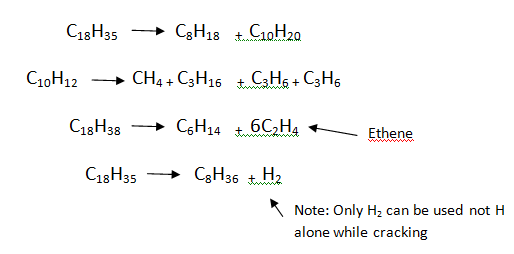
  • Cracking is a reaction, in which bigger Alkane/ H molecules are broken into smaller molecules.             `
  • The longer chain Alkanes are converted into smaller chain Alkanes, Alkenes and Hydrogen .
  • The product formed after the rection, can have only Alkane or mixture of Alkane, Alkens and H2.
  • Number of Carbons Remain Same, In Reactants And Products.
  • Temperature requires is 600 °c
  • Alumina Al2O3 and Silica SiOare used as catalyst.
E.g.
Capture61
Uses of Cracking:
  • To produce akanes and alkenes and Hydrogen.
  • To breakup large hydrogen carbon molecules into smaller ones to produce fuel for motor vehicles.
  • Ethene is produced, It is useful in production of Ethanol and Plastic (Polyethene).

Isomerism:

  • Isomers are organic compounds with the same molecular formula but different structural formula.
  • Due to difference in chain length (structural properties), they have different physical properties (e.g. Boiling point, Melting point)
  • They can occur in both Alkanes and Alkenes
  • As the # of Carbon atoms increases, the number of isomers also increases.
  • As they have same molecular formula, therefore their percentage composition by mass remains the same.
  • Isomerism is used in the petroleum industry e.g. car eng
Capture58B                                                                       Capture58A

Introduction to Organic Chemistry

Homologous Series:

A set of organic compounds with similar chemical properties, with a general formula and showing a gradation in physical properties as a result of increase in the size of mass of the molecule.
The formula of each member differs from the previous one by an extra –CH2 group of atom.

Members in Homologous Series have:

  • Same chemical reactions
  • Same general formula
  • Same functional group (OH – COOH)
  • Different physical property ( difference in Carbon atom, Melting point and Boiling point)
Why higher Boiling Point:
As the number of Carbon atoms increases, the intermolecular forces of attraction also increases, hence the more difficult it gets to break the molecules apart. (More heat energy is needed)

Functional Group:

An atom or group of atoms which give the molecule its characteristics properties. E.g. (C-C)

Fractional Distillation Of Crude Oil:

  • Petroleum which is a non renewable energy is a mixture of different organic compounds present in depth of soil or sea.
  • Fractional Distillation is used to separate crude oil into its components.
  • Petroleum Column is 300 m in length, therefore more efficient.

Uses of Petroleum Fractions:

Refinery Gas – Used as a fuel for cooking, heating  – portable
Gasoline/ Petrol – Fuel for car
Naphtha – Used in Petrochemical Industry, production of plastic and detergents
Kerosene / Paraffin – Jet fuel
Diesel Oil / Gas oil – Diesel engines
Lubricating Oil  – Lubricating oils , waxes and polishes
Bitumen / Asphalt – Paving road surfaces, waterproofing material

Moving Up The Group Increase in:                           
  • Volatility
  • Ease of Ignition
Moving Down The Group  Increase in:
  • Boiling point
  • Viscosity
  • Carbon atoms in molecule

Stoichiometry & The Mole Concept

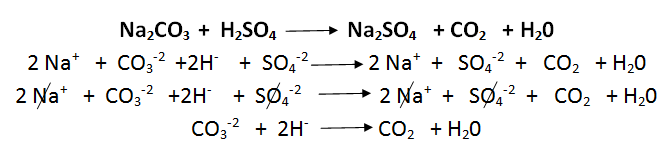
Writing Ionic Equations:

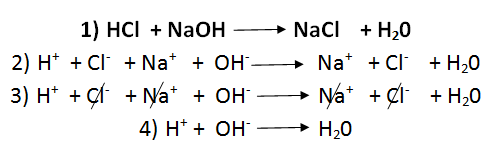
An ionic equation is a simplified chemical equation that shows the reactions of ionic compounds in water.
Ionic compounds are those compounds, which are soluble in water.
Inorder to write an ionic equation:
  • Write the balanced chemical equation of the reaction. Include the state symbols.
  • Identify ionic compounds that are soluble in water. These compounds become ions in H20. Rewrite the chemical equation in terms of ions.
  • Cancel out the spectator ions (Common).
  • Write the ionic equation.

Examples:Capture45
Balancing Ionic Equations

Relative Atomic Mass (Ar):

The mass of an atom compared with the Carbon – 12 atom is called its relative atomic mass.
The mass of one mole of atoms is its “relative  atomic mass” in grams.

Relative Molecular Mass (Mr):

The mass of a substance made of molecules is known as Relative Molecular Mass.
Hydrogen has (1*2) =   2      and H20 has relative molecular mass of (1*2) + 16 = 18

Relative Formula Mass (Mr):

The mass of a substance made of ions is known as relative formula mass.  Ammonia (NH3) has Mr of (1*14) + (3*1) =  58.5.

The Mole:

A mole of a substance is the amount that contains the same number of units as the number of Carbon atoms in 12 grams of carbon-12.

Avogradoe’s Number:

Number of Particles in one mole = 6.02 * 1023
Stoichiometry And The Mole Concept
Number Of Moles

Percentage Compostition of Compounds:

Percentage by mass of an element in a compound
Capture49
Example:
Percentage of Hydrogen in Hydrogen Per Oxide:
Capture50
Water in Coppoer(II) Sulphate:
Capture51

Emperical Formula:


Emperical Formula of a compound shows:
  • Types of elements present in it.
  • Simplest Ratio of the different types of atoms in it.

Inorder to Find the Emperical Formula of a compound:
  • Write down the each percentage/ mass separately.
  • Divide each by their Mr.
  • Now divide all of them with one which has the lowest ratio.
  • If any one of the answer is in the decimal form, multiply both with any number (lowest) to get make it a whole number

Examples:
A  compound has 40% Carbon 6.6% Hydrogen & 53.3% Oxygen. Calculate the Emperical Formula of the compound.

C                              H                                O
40                            6.6                            53.3
40/12                      6.6/1                          53.3/16
3.33                         6.6                              3.33
3.33/3.33               6.6/3.33                     3.33/3.33
1                              2                                 1

Emperical Formula: CH2O

E.g 2  O.72g of Mg combines with 0.28g of Nitrogen. Find its Emperical Formula.
Mg                               N
0.72                           0.28
0.72/24                      0.28/14
0.03                           0.02
0.03/0.02                  0.02/0.02
1.5                              1
1.5 * 2                        1 * 2
3                                 2
Emperical Formula :Mg3N2

Molecular Formulae:

The molecular formula shows the actual number of atoms that combine to form a molecule.
To Find the molecular Formula:
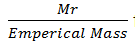
  • CalculateCapture52for the compound. This gives the number n.
  • Multiply the numbers in the empirical formula n.

E.g. Emperical Formula = HO
Relative Molecular Mass = 34
(H = 1 , O = 16) . Find Molecular Formula?
34/17 =  2
HO * 2  = H202

Calculating The Volume of  Gas:

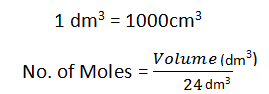
1 Mole of every substance occupies 24dm3.
Capture53
Concentration:
1 dm3 = 1000cm3
The Concentration of a solution, is the amount of solute in grams or noles, that is dissolved in 1 dm3 of solution.
Capture54
Percentage yield:
Yeild is the amount of product, obtained from a reaction.
Capture55
Actual Yeild:
It is the amount collected at the end of a chemical reaction. The actual yield is always less than the theoretical yield. It is also known as the Practical Yeild.
Theoratical Yeid:
It is the calculated yield of the amount of prosuct by using stoichiometry. In this Yeild 100% reactants are converted to products, with no losses.
Percentage Purity:
Percentage Purity indicates the amount od pure substance present in a sample of chemical substance.
Capture56